Etsy for Beginners: Build Your First Product Range Without Making 47 Random Things
Jul 01, 2026Etsy for Beginners: Build Your First Product Range Without Making 47 Random Things
Prefer to listen instead? Stick the podcast on while you make, pack orders, tidy your desk for 12 seconds, or pretend you’re not avoiding your Etsy descriptions.
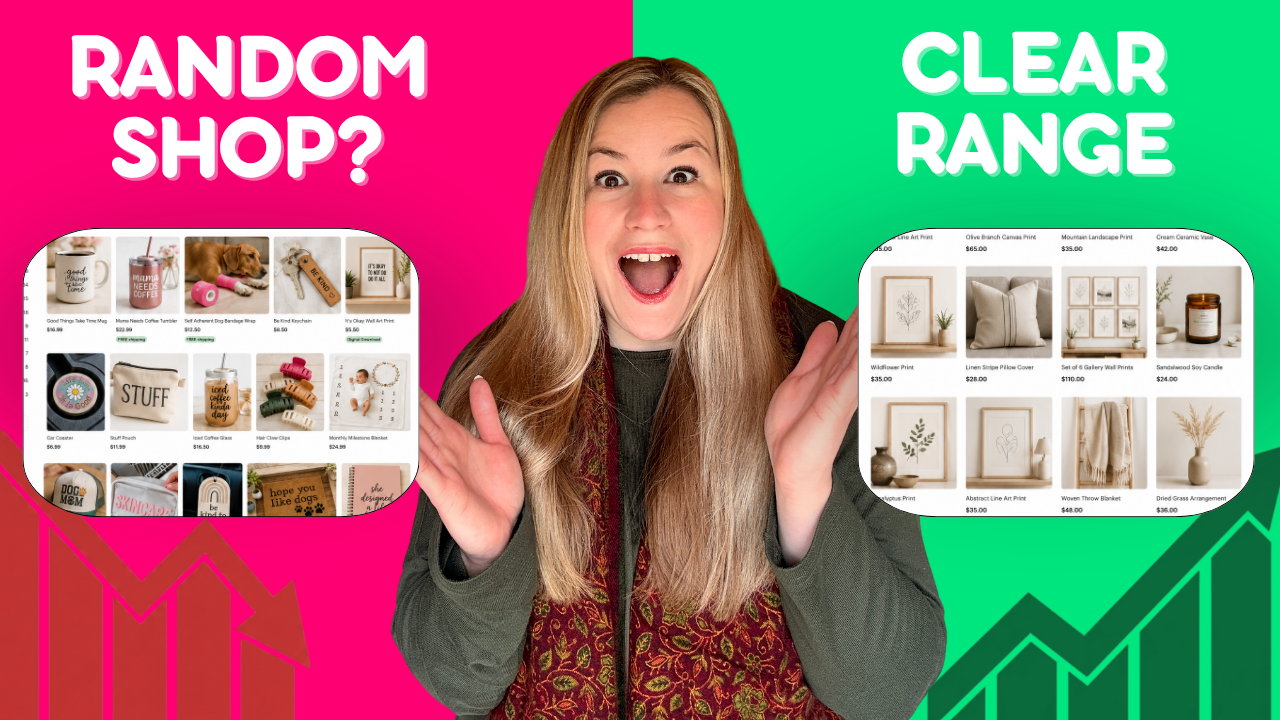
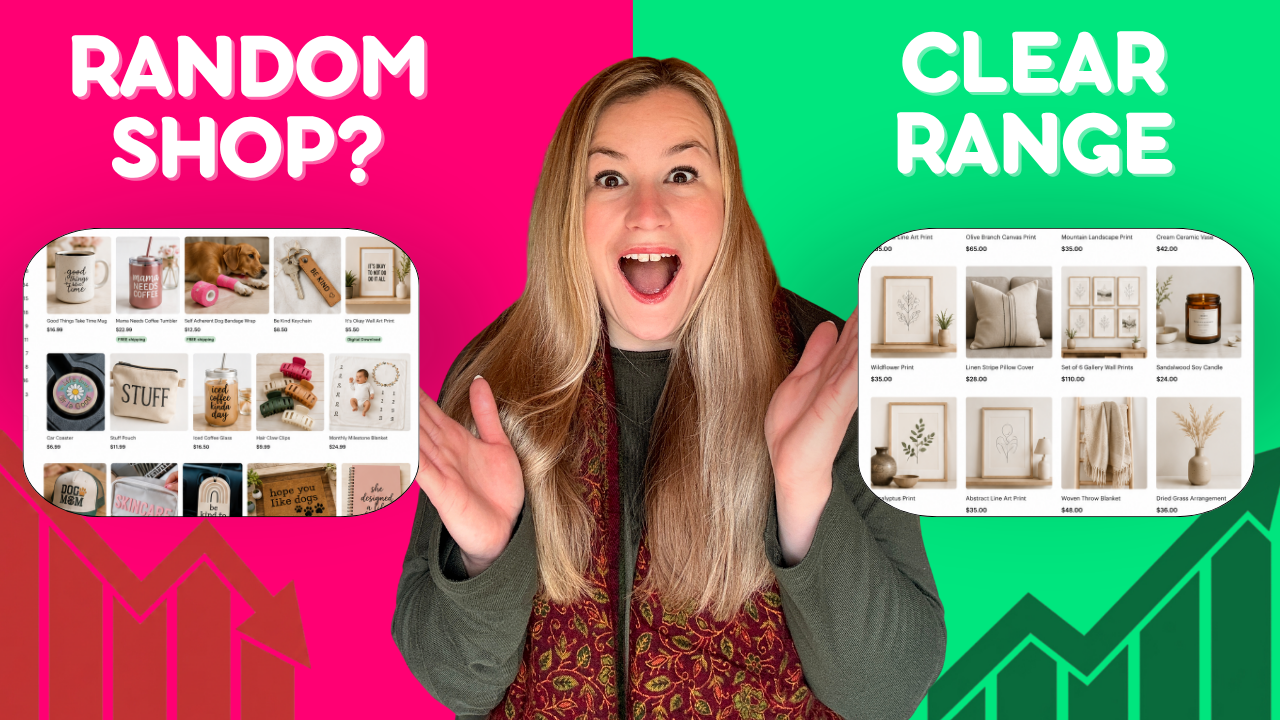
If your Etsy shop currently looks like you opened your craft cupboard, sneezed, and uploaded whatever fell out…
This is for you.
Lovingly.
Because one of the biggest beginner mistakes I see is thinking:
“More products means more chance of sales.”
So you list a keyring.
Then a candle.
Then a crochet pumpkin.
Then a bracelet.
Then a personalised mug.
Then one lonely Christmas bauble from 2022.
And suddenly your Etsy shop feels less like a brand and more like a village hall raffle table.
And listen.
I get it.
You’re creative.
You can make lots of things.
That is lovely.
But just because you can make 47 random things does not mean they all belong in your first Etsy product range.
I’m Steph from Handmade Bosses, and today we’re going to talk about how to build your first simple product range so your shop feels clear, focused, and much easier for buyers to understand.
No panic.
No niche crisis.
No whispering, “But what even is my brand?” into a half-drunk cuppa.
We’re keeping it practical.
How many products should you start with on Etsy?
This is especially for you if you’re new to Etsy and wondering:
- How many products should I start with?
- Should they all match?
- Can I sell different things?
- What if I get bored making the same thing?
- What if I pick the wrong thing?
First.
Breathe.
You do not need a perfect product range.
You need a clear starter range.
There is a difference.
A perfect range makes you overthink.
A starter range helps buyers understand what your Etsy shop is about.
That’s the goal.
Stop thinking in single random products
The first shift is this:
Stop thinking:
“What product should I list next?”
Start thinking:
“What group of products makes sense together?”
Because buyers don’t just judge one listing.
They judge the whole shop.
They click on a product.
Then they often have a little nosy around.
As they should. We all love a nose.
And when they look around, they’re asking:
- Does this shop feel like it knows what it’s doing?
- Does everything make sense together?
- Is this seller the right person for this kind of product?
- Can I trust this?
So if your Etsy shop has a baby blanket, a gothic bookmark, a dog bandana, and a random resin coaster…
The buyer might like one item.
But the overall shop can feel confusing.
Not bad.
Just unclear.
And unclear makes people hesitate.
Your Etsy product range needs a shared thread
This does not mean every product has to be identical.
You do not need to make 27 versions of the exact same thing until your soul gently leaves your body.
It means your products need a shared thread.
A reason they belong together.
Think of it like a little product family.
Not a weird family reunion where no one knows why Uncle Keith brought a kayak.
A product family.
Pick one organising idea for your first Etsy product range
Your first product range needs one organising idea.
This is what keeps it from becoming chaos with a shipping profile.
You can organise your range around:
- One buyer
- One occasion
- One product type
- One use
- One theme
Let’s break that down.
One buyer
This means your products are for the same type of person.
For example:
- Gifts for dog mums
- Accessories for brides
- Keepsakes for new parents
- Stationery for teachers
- Jewellery for book lovers
One occasion
This means your products are connected by when someone would buy them.
For example:
- New baby gifts
- Wedding party gifts
- Teacher thank-you gifts
- Christmas stocking fillers
- Birthday gifts for milestone ages
One product type
This means your shop starts with one clear kind of product.
For example:
- Personalised mugs
- Handmade candles
- Embroidered hoops
- Clay earrings
- Crochet plushies
One use
This means your products help with the same kind of thing.
For example:
- Desk organisation
- Self-care evenings
- Nursery decor
- Gift wrapping
- Party decorations
One theme
This means everything shares the same visual or emotional world.
For example:
- Cosy autumn
- Book lovers
- Cottage garden
- Colourful maximalist decor
- Calm neutral nursery style
The problem starts when you try to use all of these at once.
You’re making earrings for brides, mugs for dads, wall art for babies, and candles for people who like frogs.
And I’m not saying frogs don’t deserve candles.
They probably do.
But for a beginner Etsy shop, that is too many directions.
Pick one organising idea first.
That gives your shop a backbone.
A wobbly little beginner backbone, maybe.
But still a backbone.
Build variations, not random new products
Once you’ve picked your organising idea, the easiest way to build a range is with variations.
This is where beginners make life too hard.
They think every new listing has to be a completely new idea.
It doesn’t.
A strong starter range can be one core product with smart variations.
Example: personalised baby blankets
Instead of making blankets, mugs, prints, candles, and keyrings, your first range could be:
- A name blanket
- A birth flower blanket
- A first Christmas blanket
- A rainbow baby blanket
- A matching comforter
That is a product range.
It all makes sense.
Same buyer world.
Same gifting moment.
Same shop purpose.
Example: polymer clay earrings
Your first range could be:
- Studs
- Small hoops
- Statement earrings
- Bridal white earrings
- Autumn colour earrings
- A gift box option
Again, it makes sense.
You are not reinventing your whole business every time you list something.
You are building around a clear product world.
Think:
Core product first.
Then variations around:
- Colour
- Size
- Occasion
- Personalisation
- Bundle options
- Gift upgrades
Not chaos first and emotional recovery later.
Your product range should answer buyer questions
A good product range does not just look pretty.
It helps buyers make decisions.
Let’s say someone lands in your shop looking for a bridesmaid gift.
If they see:
- One bridesmaid bracelet
- One Halloween print
- One baby blanket
- One teacher mug
They might think:
“Hmm. Is this shop really for weddings?”
But if they see:
- Bridesmaid bracelet
- Maid of honour bracelet
- Mother of the bride bracelet
- Flower girl bracelet
- Gift box upgrade
- Matching necklace
Suddenly the buyer thinks:
“Right. This seller understands this occasion.”
That builds confidence.
And confidence helps sales.
Your range should answer:
- What is this shop good at?
- Who is it for?
- What choices does the buyer have?
- Can they buy more than one thing?
- Does this feel like a proper shop?
Not corporate.
Not soulless.
Just clear.
Because handmade does not have to mean messy.
It can still feel warm, personal, and thoughtful without looking like you listed everything you’ve ever made since 2017.
Start smaller than you think
So, how many products should you start with on Etsy?
There is no magical number.
And anyone pretending there is needs a biscuit and a lie down.
But for beginners, I would rather you start with a small, focused range than a huge random one.
Think:
5 to 10 strong listings that clearly belong together.
Not 40 rushed listings that make your shop look like it’s having an identity crisis.
And yes, more listings can give you more chances to be found.
But only if those listings are good.
They still need:
- Clear photos
- Searchable titles
- Helpful descriptions
- Strong keywords
- Sensible pricing
- A buyer who understands what they’re looking at
More weak listings do not fix the problem.
They just give you more things to be annoyed about.
So start with a tight little range.
Get it looking clear.
Then expand.
Use Etsy stats to decide what to make next
Once your range is live, do not immediately run off and create 19 new products because you saw a TikTok.
Watch what people do.
Look at your Etsy stats.
Ask:
- Which listings get views?
- Which ones get favourites?
- Which ones get clicks but no sales?
- Which products do people ask questions about?
- Which ones do people add to basket?
- Which ones actually sell?
That information tells you where to expand.
If your teacher mug gets attention, maybe you add:
- A teacher coaster
- A teacher keyring
- A personalised teacher gift box
If your bridesmaid bracelet sells, maybe you add:
- Matching earrings
- A gift bundle
- A maid of honour version
If your baby blanket gets favourites but no sales, maybe the product is interesting but the price, photos, delivery, or description need work.
This is how you build a product range properly.
Not by guessing wildly in the dark like a business goblin.
By looking at what buyers are showing you.
Tiny clues.
Tiny data breadcrumbs.
Follow those.
Keep your Etsy shop easy to understand
Here’s the simple test.
If a buyer lands in your shop, could they describe what you sell in one sentence?
For example:
“This shop sells personalised gifts for new babies.”
“This shop sells colourful clay earrings.”
“This shop sells cosy handmade candles for gifting.”
“This shop sells wedding party jewellery.”
That is what you want.
If the sentence is:
“This shop sells mugs and prints and blankets and earrings and some wax melts and maybe bookmarks, but I’m not sure what the vibe is…”
We need to tighten it.
Not forever.
Just for now.
You can expand later.
You can evolve later.
You can add more collections later.
But in the beginning, clarity is your friend.
Not boring clarity.
Money clarity.
The kind that helps buyers get it quickly.
Quick recap: how to build your first Etsy product range
If you’re building your first Etsy product range:
- Stop thinking in single random products
- Pick one organising idea
- Build variations around a core product
- Make sure the range helps buyers feel confident
- Start smaller and stronger
- Use Etsy stats to expand based on buyer behaviour
- Keep the whole shop easy to understand
That is how you build a starter range without making 47 random things and slowly losing your mind in a pile of bubble mailers.
What if your product range is good, but buyers still aren’t buying?
If you’ve already got products listed, but you’re not sure whether buyers are actually understanding them, I’ve got something that can help.
It’s called Why Your Etsy Listings Aren’t Selling Yet - and What To Do About It.
It will help you spot where your listings might be confusing buyers, missing key information, or not giving people enough confidence to click and buy.
Because sometimes your product range is good.
But the way the listings explain it?
Bit wonky.
Very fixable.
Before you make another random product
Before you make another completely random product because you’re bored, excited, avoiding your descriptions, or all three…
Pause.
Ask:
- Does this belong in the range I’m building?
- Will it make the shop clearer?
- Will it help the buyer choose?
If yes, brilliant.
If no, pop it in the “later” pile.
Not the bin.
Just later.
Because you are not trying to prove you can make everything.
You are trying to build a shop buyers understand.
And that is where beginner Etsy shops start to feel like proper businesses.