Etsy for Beginners: How to Know If Your Handmade Product Is Ready to Sell
Jun 24, 2026Etsy for Beginners: How to Know If Your Handmade Product Is Ready to Sell
Prefer to listen instead of read? Pop the kettle on and listen to this as a podcast while you make, pack orders, or stare lovingly at your craft supplies wondering why there are seven pairs of scissors and none of them work.
If you’re about to open an Etsy shop and your whole plan is basically:
“I make nice things, so hopefully someone buys them.”
We need a tiny pause.
Not a panic.
Not a lying-on-the-floor moment.
Just a pause.
Because one of the biggest mistakes Etsy beginners make is opening a shop before checking whether their handmade product is actually ready to sell.
Not whether it’s pretty.
Not whether your mate likes it.
Not whether your auntie said, “You should totally sell these.”
I mean properly sellable.
Clear.
Giftable.
Priced with profit.
Easy enough to make again.
And obvious enough that a stranger can look at it and think:
“Yep. I know who this is for and why I’d buy it.”
That is what we’re checking today.
I’m Steph from Handmade Bosses, and if you’re brand new to Etsy, turning your handmade hobby into a proper business, or feeling a bit “where on earth do I start?”, this is going to save you a lot of faff.
Why a beautiful product is not always ready to sell on Etsy
A product being well-made is not the same as a product being ready to sell.
Annoying, but true.
You can make something beautiful and still have buyers scroll past because they don’t understand it quickly enough.
Or because they don’t know who it’s for.
Or because the price doesn’t make sense.
Or because it takes you six hours to make and you’re charging twelve quid, which is not a business.
That’s a hostage situation with ribbon.
So before you panic-list 25 products and hope Etsy works it out, let’s check whether your product is actually ready.
-
Can a stranger understand your product in 3 seconds?
First question.
Can a complete stranger look at your product and understand:
- What it is
- Who it’s for
- Why they might want it
In about 3 seconds?
Because buyers do not browse Etsy like they’re reading a cosy little novel.
They skim.
They glance.
They make quick decisions.
If your first photo is a super close-up of a texture, but the buyer can’t tell whether it’s a Christmas decoration, a wall hanging, a gift tag, or something their cat will launch off a shelf…
You’ve made them work too hard.
And buyers do not want a puzzle.
They want clarity.
Try the 3-second product test
Look at your top three product ideas and ask:
- Would someone know what this is without reading the description?
- Would they know who it’s for?
- Would they know how big it is?
- Would they know why it’s worth clicking?
If the answer is no, the product might not be the problem.
The way you’re presenting it might be.
Your first photo, title, and first line of your description need to work together like a tiny sales team.
Not like a confused group project where no one knows who brought the biscuits.
2. Is your handmade product for a clear buyer, occasion, or need?
Next, your product needs a clear reason to exist in the buyer’s life.
Beginners often describe products by what they are.
Buyers buy because of what the product does for them.
So instead of:
“I sell handmade candles.”
Think:
“Who is this candle for?”
Is it:
- A calming gift for stressed-out teachers?
- A new home gift?
- A bridesmaid thank-you gift?
- A cosy autumn candle for someone who wants their house to smell like they’ve got their life together?
Specific sells better than vague.
Because when a buyer sees something specific, they don’t have to do the mental gymnastics.
They think:
“That’s perfect for my mum.”
“That’s ideal for Sarah.”
“That’s exactly what I need for my friend’s birthday.”
If your product could be for everyone, it often feels like it’s for no one.
And I know that feels scary.
You think being broad gives you more chance of a sale.
But broadness makes buyers work harder.
And buyers are tired.
We are all tired.
The kettle is doing emotional support at this point.
Ask yourself these questions
- Who would buy this?
- When would they buy it?
- What problem does it solve?
- What occasion does it fit?
A handmade mug is fine.
A handmade new job mug for your work bestie is clearer.
A silver necklace is fine.
A birth flower necklace for a 30th birthday gift is clearer.
A baby blanket is fine.
A personalised new baby blanket for a winter baby gift is clearer.
You’re not necessarily changing the product.
You’re changing how easy it is for the buyer to understand it.
3. Can you make the product again without hating your life?
Now we need to talk about repeatability.
Can you actually make this product again and again?
Because sometimes the product is gorgeous.
But it takes nine hours, a full moon, three snacks, and a small argument with the glue gun.
That might not be a repeatable Etsy product.
That might be a one-off piece.
Which is fine.
But then it needs to be priced and sold like one.
The repeatability check for handmade sellers
Ask yourself:
- How long does it really take to make?
- Can I source the materials again?
- Will each one look close enough to the photos?
- Could I make five of these in a busy week?
- Would I still like this product after order number ten?
Because here’s what happens.
You make something once.
You love it.
You list it.
It sells.
Lovely.
Then someone orders another.
Then another.
Then someone asks for a custom version.
Suddenly you’re sitting at the kitchen table at midnight muttering at ribbon like it owes you money.
So your product needs to be sellable, yes.
But it also needs to be repeatable.
4. Is your product sellable, repeatable, and profitable?
Here’s the little sanity triangle:
Sellable. Repeatable. Profitable.
You need all three.
If it’s sellable but not repeatable, it may burn you out.
If it’s repeatable but not profitable, it’s a hobby with admin.
If it’s profitable but unclear, buyers may ignore it.
This is one of those boring business bits that becomes very interesting when you realise it can save you from crying into packing tissue.
5. Does the price leave room for profit?
This is where we put the big girl pants on.
Lovingly.
With a cuppa nearby.
Your product is not ready to sell if the price only covers materials and a vague whisper of your time.
You need profit.
Not just because profit is nice, although obviously, yes please.
But because profit gives your business oxygen.
It pays for:
- Packaging
- Etsy fees
- Mistakes
- Tools
- Your time
- Your ability to keep going
Because otherwise you end up thinking:
“Why am I working for less than a sad sandwich?”
Stop pricing from fear
Beginners often price based on fear.
They look at cheaper sellers and panic.
But you don’t know what’s going on behind that price.
They might be undercharging.
They might use different materials.
They might be mass-produced.
They might not be making any profit either.
So instead of asking:
“What’s the cheapest I can sell this for?”
Ask:
“Can I price this properly and still explain the value?”
You need to know your:
- Materials
- Packaging
- Fees
- Time
- Profit
If the number does not work, you have choices.
You can simplify the design.
Improve the photos.
Bundle products.
Create a premium version.
Or decide this product is lovely, but not the one to build the business around.
That might sting.
But it stings less than selling loads and realising you’ve paid yourself approximately 48p and a biscuit crumb.
6. Is there proof people buy similar products on Etsy?
Now, I am not saying copy people.
Do not go galloping into someone else’s Etsy shop with your little screenshot folder.
Absolutely not.
But you do need evidence that people buy this type of thing.
Go to Etsy and search what a buyer would search.
Not what you call it.
What they would call it.
What to look for when researching your product
Look at:
- What words keep appearing?
- What occasions are sellers mentioning?
- Which photos make you want to click?
- Are there reviews?
- Are buyers buying personalised versions?
- Are there bestsellers?
This helps you understand how buyers already think about that product.
For example, don’t just search:
“embroidered hoop”
Search:
- New baby embroidery gift
- Nursery wall art
- Personalised wedding embroidery
- Family portrait embroidery
That gives you clues.
Not so you can copy.
So you can understand the shelf your product belongs on.
If buyers already understand that shelf, it becomes much easier for them to understand your product too.
7. Can you explain why yours is the right choice?
Final check.
Can you clearly explain why someone should buy this product from you?
Not in a cringey “made with love and passion” way.
I mean practically.
Is it:
- Personalised?
- Gift-ready?
- Made to order?
- Eco-conscious?
- Designed for a specific occasion?
- Available in colours buyers actually want?
- Packaged beautifully?
- Made with better materials?
- Quick to dispatch?
- More thoughtful?
- More specific?
Buyers need reasons to feel confident.
Especially when your shop is new and you don’t have loads of reviews yet.
So your Etsy listing needs to reduce hesitation.
Describe the product in a way buyers understand
Instead of:
“Handmade bracelet available in different colours.”
Try something clearer:
“Personalised birthstone bracelet, gift-ready and made with your chosen initial. Perfect for birthdays, bridesmaids, or a thoughtful little thinking-of-you gift.”
One describes the item.
The other helps the buyer imagine buying it.
And that matters.
Because buyers are asking:
- Who is this for?
- Will they like it?
- Will it arrive nicely?
- Is it worth the price?
- Can I trust this seller?
Your job is to answer those questions before they have to ask.
Quick recap: is your handmade product ready to sell on Etsy?
Before you decide your handmade product is ready to sell on Etsy, check:
- Can a stranger understand it quickly?
- Is it for a clear buyer, occasion, or need?
- Can you make it consistently?
- Does the price leave room for profit?
- Is there evidence people buy similar things?
- Can you explain why yours is the right choice?
That is how you move from:
“I make nice things.”
To:
“I’m building a shop that makes sense to buyers.”
And that shift is huge.
What if your product has potential, but your listings are letting it down?
If you’re reading this thinking:
“Right. I think my product could sell, but my listings might not be doing it justice.”
That is very fixable.
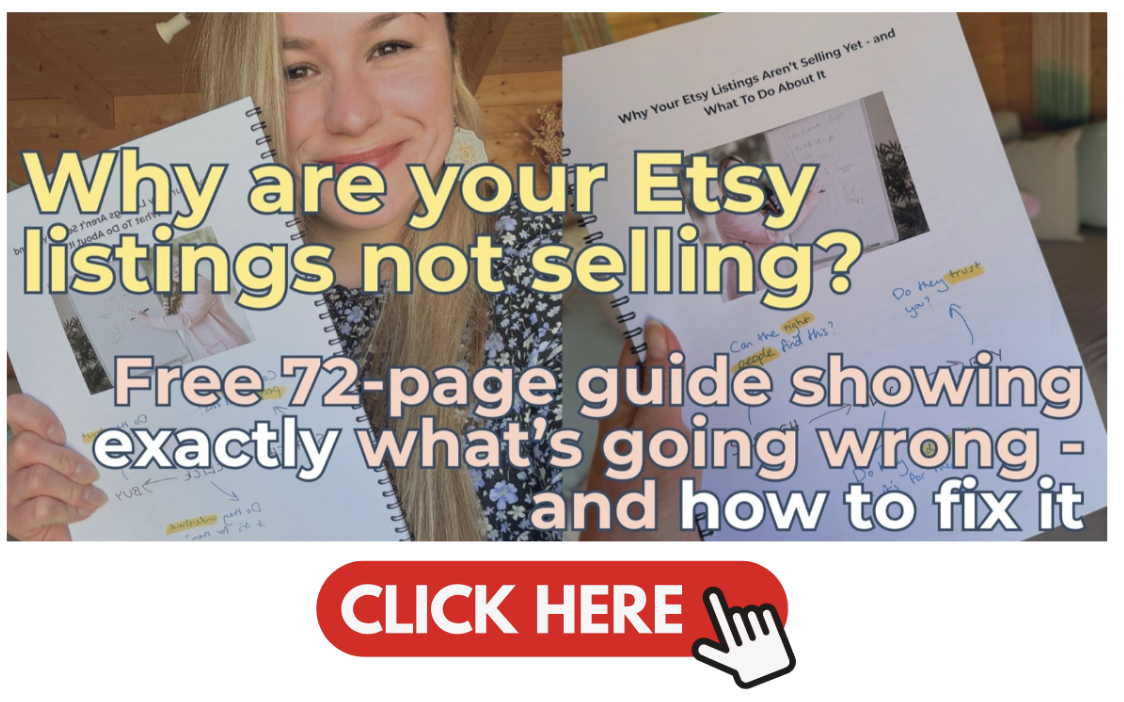
I’ve got a free resource called Why Your Etsy Listings Aren’t Selling Yet - and What To Do About It.
It will help you spot what might be stopping buyers from clicking, trusting, and buying.
Because sometimes the product is not the problem.
Sometimes the buyer just doesn’t have enough clarity to feel confident.
And once you can see that, you can fix it without throwing the whole shop into the sea.
Final thought before you list 25 random products
Before you build a whole Etsy shop around 25 random ideas, start with one product.
Run it through these checks.
Be honest, but don’t be horrible to yourself.
We’re not doing business by emotional ambush.
We’re doing it with a cuppa, a plan, and slightly less faff.
And if you want something to help you check your listings next, grab Why Your Etsy Listings Aren’t Selling Yet - and What To Do About It.
It fits with this beautifully.
Like biscuits and tea.
But with more profit.