


Switching Your Etsy Shop from Hobby Mode to Business Mode
Oct 05, 2026
OK, so your Etsy shop is open, you’ve made sales, you’ve got reviews! and you probably have a few products that sell better than the others, and you’re well past the point of wondering where the “open shop” button is now.
But somehow, the business still feels a bit... improvised?
One month it's brilliant - the next is quiet and you’re not really sure why... You add products when inspiration strikes, change things when sales slow down and make quite a lot of decisions based on whatever seems like a good idea that week.
If that sounds familiar, you don’t necessarily need to start again!
You might just be ready to move your Etsy shop from hobby mode into business mode.
And I’m not using “hobby” to mean small, part-time or not serious... You can run a very real, profitable business from your kitchen table for three days a week - The difference is how you run it.
Business mode is knowing:
- What is working
- What is making you money
- Where your time is going
- Why you’re making the decisions you’re making.
All of this above gives us some data/information useful to work with.
I’m Steph from Handmade Bosses, and in this article I'm going to talk about where I’d start with all this...
Stop judging the business by sales alone
When you’re new to Etsy, getting a sale is a big deal!
It’s proof that somebody who isn’t your mum is prepared to give you actual money for something you made 😂
Once you’ve been selling for a while though, the number of sales doesn’t tell you enough...
Let's imagine for a moment that two Etsy shops both make £3,000 in a month.
One owner has healthy margins, manageable products and enough capacity to fulfil the orders comfortably.
The other is spending almost all of that revenue on materials, working every evening and making very little once everything has been paid for.
On paper, both shops did £3,000 - but in reality, they’re in very different positions...
So instead of only asking “How much did I sell?” start asking “What did those sales actually leave me with?”
Look at the real cost of making your products, your selling costs, your time and what profit is actually left.
A product can sell really well and still not be a particularly good product for the business.
On this note, If you’ve never properly checked your pricing, my guide on whether your Etsy prices are too low is a useful place to start.
You don’t need to spend the next three days building an enormous finance spreadsheet, just pick a few of your important products and get a clearer picture of what they’re actually doing for you.
Work out which products are doing the heavy lifting
Established shops usually have some history behind them...
You’re no longer guessing what people might buy as you’ve already got actual customers showing you what they do buy.
So have a look at your product range and ask yourself:
- Which products sell most consistently?
- Which make you the best profit?
- Which are easy to fulfil?
- Which take ages to make for very little return?
- Which seem to bring new customers into the shop?
- Which work particularly well at certain times of year?
- Which products are mainly still there because you made them three years ago and nobody has ever really questioned their existence?
Once you know the answer to these questions, it doesn't mean you then have to immediately delete half the shop!
The point is to stop treating every listing as though it has exactly the same value to the business.
Let’s say one product sells ten times a month, has a healthy margin and is straightforward for you to make.
Another sells once every four months, takes ages to make and uses materials you only buy for that one item.
Those products are not doing the same job... and so, your time probably shouldn’t be split equally between them either right?
Stop adding products just because you fancy making them
This one is particularly difficult when the reason you started a handmade business was that you quite like... making things (fair enough)!
A new material arrives and you see an idea... Christmas is coming up and suddenly you’re six products deep into a collection nobody asked for!
Creativity is obviously part of the business - and I don’t want you turning your product development into a joyless spreadsheet exercise.
But once you already have sales evidence, use it.
So before adding another product, ask what makes this one useful?
- Maybe customers have asked for it?
- Maybe it goes naturally with a bestseller?
- Maybe you’ve noticed a particular occasion or style performing really well?
- Maybe it fills an obvious gap in your range?
(or maybe you genuinely want to test something completely new)?
All of those can be reasonable answers... You just want a little more behind the decision than “Ooh, I could make that.”
Because every new product also creates another listing to photograph, price, optimise, stock, market and fulfil... The making bit is often the easy part.
Don’t assume every sales problem needs more traffic
This is another shift I’d make once your shop has some history...
A quiet Etsy shop does not automatically need more people sent to it, and, if hardly anybody is finding you - then yes, visibility may need work.
But if plenty of people are already arriving and they’re not buying, then sending another 500 people to the same listings may not solve very much.
So (as in the previous sections) before you decide what to work on, let's look at where things seem to be going wrong and ask ourselves some questions - for instance...
- Are people finding the products?
- Are they clicking?
- Are they buying?
- Are particular products converting much better than others?
And this is the point where having real business data becomes useful... You’re not changing something because you may have seen a reel or announcement on social media saying that everybody needs to rewrite their tags by Tuesday.
You’re looking at your shop and working out what (specifically) what it needs.
And if you’re currently getting traffic but still can’t work out why the sales aren’t following, this will help...
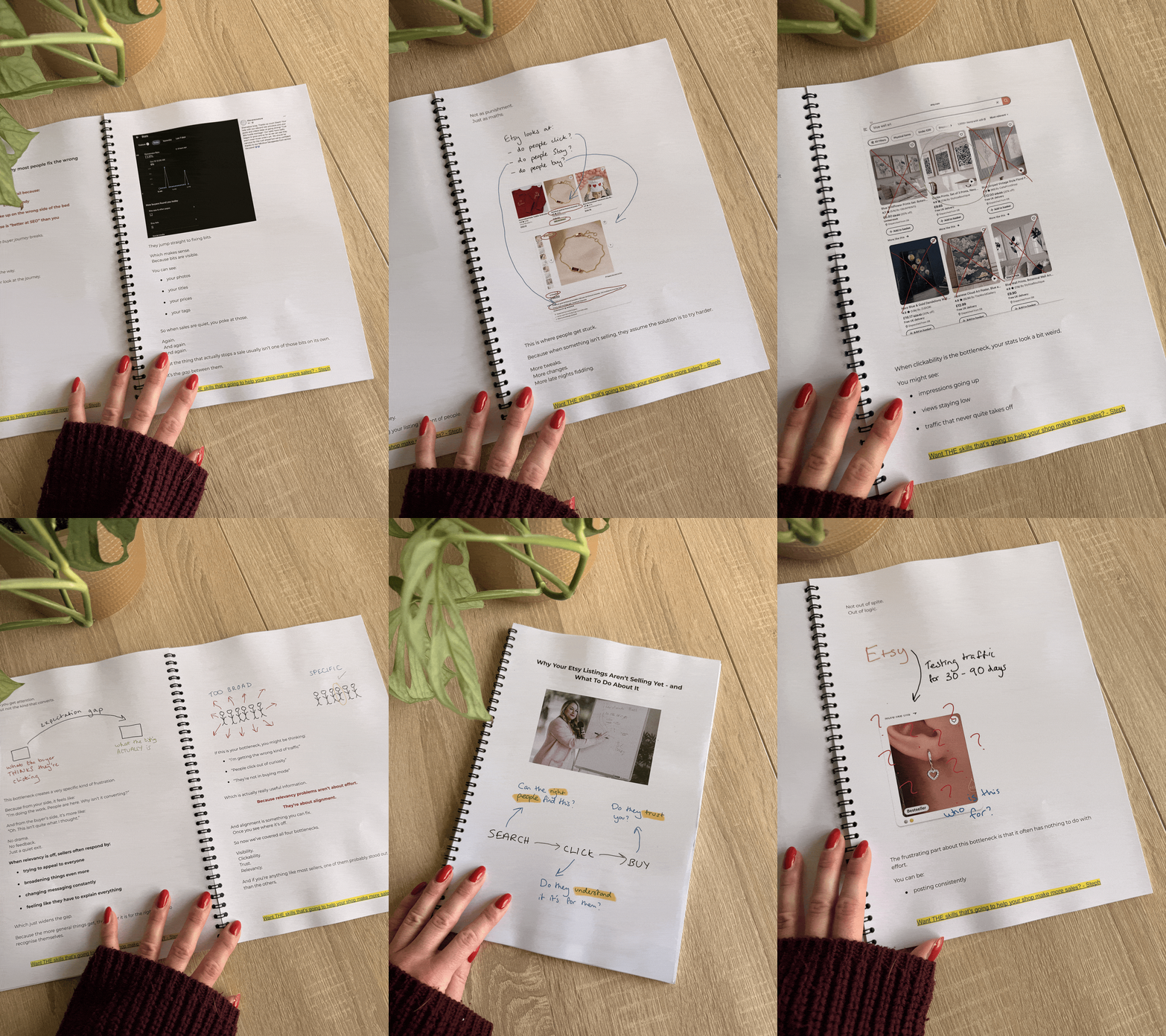
Wondering why your Etsy listings aren't selling?
I've put together a free 72-page guide to help you figure out what's actually stopping the sales and what to do about it.
✅ Find out why people aren't buying
✅ See what needs fixing first
✅ Get a clear plan instead of guessing
GET THE FREE GUIDE →
Stop changing everything when sales go quiet
Having an established shop gives you something that a brand-new Etsy seller doesn’t yet have... history.
So use it!
In this example, let’s say that you have a quiet week...
You could immediately change your prices, photographs, SEO, ads (if you're using them) and half of your product range.
Or you could look at what normally happens at this time of year, compare the traffic with previous periods and see whether anything has actually changed.
One quiet week is information - it isn’t necessarily a business emergency...
If your traffic is similar but conversion has fallen, that points you in one direction.
If conversion is fine but traffic has dropped, that points somewhere else.
If your Christmas products always go quiet in January... we probably don’t need an emergency meeting about it).
This is one of the biggest differences between guessing and using evidence.
You still won’t always know exactly why something happened (businesses are annoyingly unwilling to provide a neat explanation for every wobble). 😂
But you can make a much better decision when you look at the information you already have before changing things.
Which leads me onto my next point - and that's, If your shop has been sitting at roughly the same level for a while, my article on why your Etsy shop is stuck will help you to look at what may be holding the next stage back.
Make the repeated jobs easier
Once you’ve been selling for a while, certain jobs start repeating...
You answer the same customer questions, package the same products, order the same supplies, send similar messages and check the same things before dispatching etc.
At this stage, that’s usually the point where a little bit of organisation starts saving you time (and - just to be clear, I do mean a little bit).
If you type the same customer reply every week, then save it somewhere to quickly load up, copy (make any slight adjustments) and send over.
If you constantly run out of one packaging item - decide/schedule when you’ll reorder it.
If personalised orders involve checking the same information every time - make yourself a small checklist.
If you spend ten minutes looking for ribbon every time an order comes in, perhaps the ribbon needs a dedicate home!
Nothing overly-complicated here, but just some quick hints, tips and advice to (try) and make your life just a little bit easier.
The overall aim is simply to stop using your brain to remember things that happen the same way over and over again... systems should make the business easier to run - but if maintaining the system takes longer than doing the actual job, we may have got slightly carried away.
Know how much work your products create
More sales sound brilliant until you’ve got 47 orders to make and every single one takes two hours 😭
This matters much more in a handmade business than it does in plenty of other businesses because often you are part of the production process.
So look at your capacity...
- How many orders can you comfortably manage?
- Which products take the longest?
- Are there particular parts of production you can batch?
- Do personalised orders create much more work than standard ones?
- What happens when Christmas gets busy?
- Are you forever extending dispatch times because you’ve taken on more than you can comfortably make?
Knowing that doesn’t mean limiting your ambition, It helps you work out what kind of growth you actually want.
If something sells really well but takes four hours to produce, then there might eventually be a pricing decision, a process decision or a capacity decision to make...
The answer doesn’t have to be “Get even more orders.”
Sometimes the stronger business decision is improving the orders you already get...
Look at profit before automatically chasing more revenue
Revenue is very easy to get excited about - It’s a lovely number after all! 😁
But unfortunately, the suppliers, Etsy and Royal Mail etc. are all quite interested in parts of it too.
So as your business becomes more established, I’d pay much more attention to what happens after the sale? i.e.
- Which products produce healthy profit?
- Which sell well but eat through expensive materials?
- Which require lots of customer messages?
- Which regularly need remaking?
- Which are difficult to package?
- Which create lots of small add-on sales?
You might discover that the product you thought was your superstar isn’t actually the one doing the most useful work...
You might also find a fairly boring little product quietly sitting there making lovely margins without causing you any trouble!
And for a bigger look at this stage of growth, my Etsy Profit Playbook goes further into building a stronger shop once you’ve moved beyond simply trying to make more sales.
Decide what you actually want the Etsy shop to do for you
Now this one may sound obvious, but plenty of businesses keep growing without anybody stopping to ask what they’re trying to grow into.
Your goal when you opened the shop may have originally been “Please can somebody buy one of these?”
But once that has happened a few hundred times, you can set a slightly more useful target right?
Maybe you want dependable extra income alongside another job?
Maybe you want this to become your full-time income?
Maybe you want a small premium business with fewer orders and better margins?
Maybe you love the Christmas rush and quite like having quieter months afterwards?
Maybe you eventually want a team?
(or, maybe you absolutely do not!)
There isn’t a correct version, but the answer matters because it affects what you do next.
Somebody who wants 30 well-paid orders a month shouldn’t automatically follow the same growth plan as somebody trying to build a high-volume business.
So before adding more products, platforms or workload, ask yourself “Does this move me towards the business I actually want?”
This question alone can remove quite a lot of unnecessary jobs!
Remember that Etsy is where you sell - not the whole business
When most of your orders come through Etsy, it’s very easy for the two things to become the same in your head.
“My Etsy shop” becomes “my business”.
But your business is bigger than the platform.
It includes your products, customers, pricing, marketing, profit, fulfilment and the experience people have when they buy from you.
Etsy is an important part of that system.
That doesn’t mean you suddenly need your own website, wholesale accounts, an email list, four social platforms and a Pinterest strategy (ultimately, please don’t leave this article with seventeen new jobs) 😂
It just means that as the business grows, you make decisions based on what is right for the business, rather than automatically assuming everything needs to revolve around one platform.
There may come a point where another sales route makes sense - there may not.
You can make that decision when you have a reason to.
What matters less than you think?
There are a few things I’d stop using as proof that your Etsy shop is or isn’t a “proper business”.
How many hours you work... Working until midnight does not make it more legitimate - It mainly makes you tired.
How many products you have... A focused shop with 30 profitable products can be a stronger business than a shop with 300 listings nobody understands.
Whether you have a team... Plenty of excellent handmade businesses stay deliberately small!
Whether you have your own website... It can absolutely be useful - but having one does not automatically graduate you from Etsy seller to CEO.
How busy you feel... Busy and profitable are not the same thing.
The useful measures are much less glamorous... i.e.
- Do people want what you sell?
- Are the sales profitable?
- Can you deliver them properly?
- Do you understand what is working?
- Can you repeat more of the good bits without making the business worse?
This above tells you far more.
Your next step: find the most “hobby mode” part of the business
You don’t need to overhaul everything (please don’t)!
Have a look at your Etsy shop and choose the area that currently feels the most reactive...
Maybe you’re making sales but don’t really know which products make money?
Start there.
Maybe you’ve got a huge product range and no idea which listings deserve your attention?
Start there.
Maybe orders are good but fulfilment is becoming a nightmare?
(You know what I'm going to say) Start there!
Maybe sales have plateaued and every month you try a different fix?
Then start by looking at the evidence before changing something else...
The shift into business mode isn’t about suddenly becoming very corporate... please know that
- You can still make things at the kitchen table.
- You can still change your mind.
- You can still launch something because you absolutely love it.
You’re just combining all of that creativity with a clearer understanding of what the business is actually doing... and once you know that - the next decision becomes a lot easier (and no boardroom is required) 😅


