


Should You Delete Etsy Listings That Don’t Sell?
Nov 08, 2026Should You Delete Etsy Listings That Don’t Sell?
You've got that Etsy listing... You know the one! It's been sitting there for months...
Maybe it's had a few views.
Maybe somebody favourited it once in March.
Maybe your mum looked at it.
But actual sales?
Absolutely nothing. 😬
And eventually you start wondering "Should I just delete this Etsy listing?"
Maybe.
But I definitely wouldn't delete it just because it hasn't sold...
A listing with no sales isn't automatically a bad product, and deleting it doesn't magically make the rest of your Etsy shop stronger.
Before you get rid of anything, I want to know why it hasn't sold.
Because a product nobody has really seen is completely different from a product hundreds of relevant shoppers have looked at and repeatedly decided not to buy.
Those two listings need very different decisions...
So rather than having a dramatic Etsy clear-out because something hasn't sold since Easter, let's work out whether the listing needs to be kept, improved or retired.
A listing with no sales doesn't tell us enough
This is the biggest thing I want you to understand... No sales is the result - It isn't the diagnosis.
Let's imagine you've got a handmade ceramic mug that's been listed for three months and hasn't sold.
That could mean people don't want the mug - but it could also mean hardly anyone has found it.
Or people are seeing it in Etsy Search but the first photograph isn't getting the click.
Or shoppers are clicking, but something about the price, delivery, description or trust is stopping them buying.
Or it's a Christmas mug and you're analysing its performance in February.
Very useful. 😅
Before deciding what to do with the listing, you need to understand which situation you're actually dealing with.
If you haven't already, my guide to Etsy Stats for Beginners will help you understand the difference between views, visits, orders and conversion without turning your Stats dashboard into another thing to panic over.
"Is anybody actually finding this listing?"
This is where I'd start...
Go into your Etsy Stats and look at whether the product is actually getting meaningful visibility.
If almost nobody has seen it, you don't yet have much evidence that buyers have rejected the product - they haven't really had the opportunity.
Let's say you've had 12 views.
Twelve people not buying something does not automatically tell me "Right. Nobody wants this. Kill it immediately."
I'd be more interested in why it's getting so little attention.
- Maybe the product itself has very little demand.
- Maybe your search language isn't matching what buyers actually type.
- Maybe Etsy is showing the listing in places that aren't particularly relevant.
- Maybe the first image isn't strong enough to earn the click.
- Maybe it's incredibly seasonal.
That's a visibility problem to investigate before it's necessarily a product problem.
This is also why simply looking at how long a listing has been live isn't particularly helpful...
A listing can exist for six months and barely have been seen, whereas another can be live for six weeks and have hundreds of relevant people looking at it.
Time alone doesn't tell us enough.
"People are seeing it, but are they clicking?"
Now imagine the listing is appearing in Etsy Search, but shoppers aren't choosing it.
That's different.
Your product is getting opportunities to be noticed, but something about how it appears isn't earning attention.
This is where I'd look at things like:
-
The first photograph
-
How obvious the product is
-
Whether the image stands out against similar products
-
The price buyers see in search
-
Whether the product looks relevant to what they searched for
-
Whether the product itself is appealing enough
You may discover that the product is absolutely fine, but the first image is doing it no favours whatsoever.
Or you might realise that when your product appears beside ten competing listings, the others simply make the value much easier to understand... that's useful information.
It gives us something specific to improve rather than deciding the whole product has failed.
"What if people are clicking the listing but still not buying?"
Now we've moved further through the buying journey...
People are finding you, they're interested enough to click - but they're not buying.
That means I wouldn't make visibility my first job anymore... I'd look at the buying decision.
- Maybe the photographs don't answer enough questions?
- Maybe shoppers can't understand the size?
- Maybe delivery looks confusing?
- Maybe personalisation feels complicated?
- Maybe the price isn't being supported by the value they're seeing?
- Maybe the shop doesn't yet feel trustworthy enough?
- Maybe they're simply the wrong people for the product?
This is where my article on why your Etsy shop is getting views but no sales is useful, because it goes much deeper into what to check once shoppers are already reaching the listing.
And if this is the stage you're at, I definitely wouldn't delete the listing before investigating what is stopping the sale.
You've already got evidence that something about it is earning attention - don't throw that evidence away without learning from it first.
Use that before you start deleting things purely because they haven't sold.
It'll help you work through the listing and see whether the problem looks more like visibility, the click, trust or the buying decision.
Because sometimes the listing doesn't need deleting at all - it needs fixing.
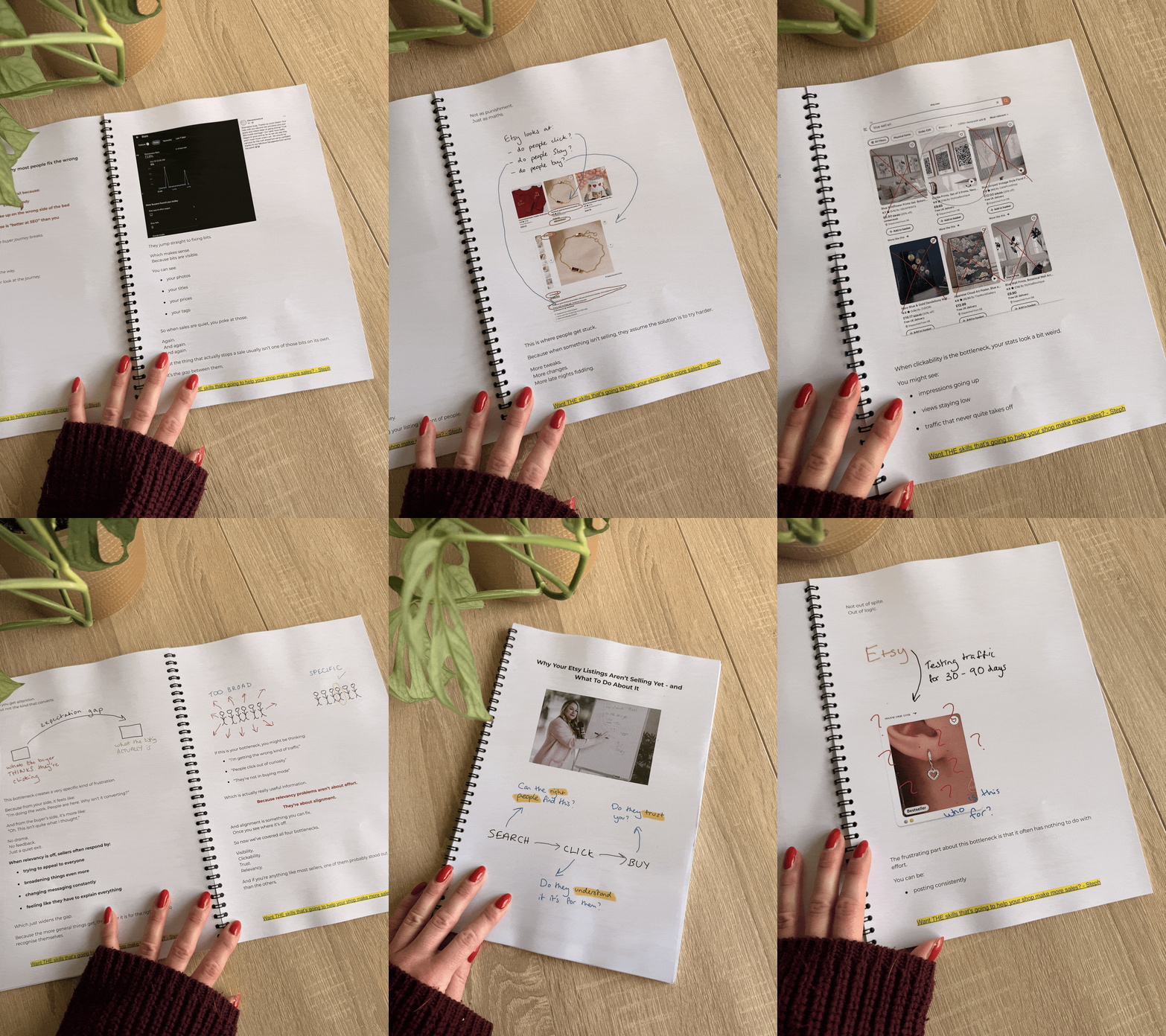
Wondering why your Etsy listings aren't selling?
I've put together a free 72-page guide to help you figure out what's actually stopping the sales and what to do about it.
✅ Find out why people aren't buying
✅ See what needs fixing first
✅ Get a clear plan instead of guessing
GET THE FREE GUIDE →
Sometimes the product genuinely isn't earning its place
Now, I don't want this article to turn into "Never delete anything! Every product is special!"
No!
Some listings genuinely do need retiring.
Once your Etsy shop has some history behind it, every product does not deserve permanent employment simply because you once spent three hours making it. 😂
You might have a product that:
-
Has had plenty of relevant visibility but consistently generates very little interest
-
Rarely sells even though similar products in your range perform well
-
Creates hardly any profit
-
Takes far too long to make
-
Uses materials you only keep for that one item
-
No longer fits the customer or brand you're building
-
Creates lots of questions or problems when it does sell
-
Has been replaced by a much stronger version
-
Belongs to a product direction you've deliberately moved away from
Now we've got more useful reasons to consider retiring it.
Notice how different that is from "It hasn't sold for three weeks."
That's not analysis - that's impatience wearing a little business hat.
Look at the product, not just the listing
This distinction matters too...
Sometimes the listing is weak...sometimes the product is weak.
Those are different problems - a brilliant product can sit inside a terrible listing.
And a beautifully photographed, perfectly written listing can still contain something very few people actually want.
You need to work out which you're dealing with.
One thing I like doing is comparing the weak product against the stronger products already in the shop.
If you've got one item that sells regularly, ask what it's doing differently.
- Does it solve a clearer problem?
- Is it bought for a stronger occasion?
- Is the style more appealing?
- Is the price point easier?
- Is it more giftable?
- Do customers understand it faster?
- Is it easier to personalise?
- Is it relevant to a bigger group of buyers?
Your successful products are giving you evidence... so use it.
This is exactly why I recommend building around products that are already showing signs of demand rather than assuming you constantly need to create more.
My article on how many Etsy listings you actually need goes into that in more detail.
Don't keep something purely because you worked hard on it
Now this one can sting slightly...
You might have spent ages designing a product.
Maybe it took weeks, maybe you bought special materials for it and maybe you're really proud of it!
None of those things automatically mean it needs to remain in your product range forever.
The work you've already done is done...
The useful question now is whether continuing to:
-
Stock it
-
Photograph it
-
Renew it
-
Market it
-
Store materials for it
-
Answer questions about it
-
Make it
still makes sense for the business you're building.
Sometimes the answer is yes... other times the product is simply slow, seasonal or niche and that's completely fine!
But sometimes you're keeping a product because removing it feels like admitting the work was wasted.
It wasn't...you tested something and you got information - now you get to use that information.
That's business.
Be careful with seasonal Etsy listings
Before retiring anything, check whether you're judging it during the wrong part of the year.
For example, a personalised Christmas decoration having a terrible February isn't particularly shocking.
Likewise:
-
Wedding products
-
Teacher gifts
-
Mother's Day products
-
Father's Day gifts
-
Christmas decorations
-
Graduation items
-
Valentine's products
can naturally have stronger and weaker periods.
Look at the product over the period when buyers would realistically be searching for it.
If you've got previous years of data, even better!
This is one of the advantages of having an established Etsy shop - you've got history.
Use it rather than treating every quiet month as though you've never seen a calendar before.
Check whether the product is actually profitable
Something selling occasionally isn't automatically a reason to keep it either.
Let's imagine Product A sells ten times a month and leaves you with healthy profit, whereas Product B sells twice a month but takes three times longer to make, uses expensive materials and creates lots of customer messages.
They are not equally valuable products just because both technically make sales.
This becomes particularly important when your shop grows.
At the beginning, you're often asking "Can I get somebody to buy this?"
Later, you need to start asking "Is this a product I actually want to keep selling?"
My guide to switching your Etsy shop from hobby mode to business mode goes deeper into this, because established sellers need to look at profit, capacity and product performance rather than sales alone.
You are allowed to retire something that technically sells if it no longer makes commercial sense.
Don't delete a listing because you're bored with it
This deserves its own section because handmade sellers are creative people - and creative people quite like... creating new things.
Shocking, I know. 😂
The problem is that you being bored of making something does not necessarily mean the customer is bored of buying it.
You might have made the same necklace 200 times and be thoroughly sick of looking at it.
Meanwhile, your customer has just discovered it for the first time.
If the product still:
-
Sells
-
Makes healthy profit
-
Fits your customer
-
Fits your brand
-
Is manageable to produce
I wouldn't retire it purely because a shiny new idea has appeared.
You might decide to change the way it's produced, increase the price, simplify the options or eventually replace it.
But use commercial evidence alongside your creative energy.
Otherwise your product range can end up being rebuilt every six months while the customer is still trying to catch up.
"Should I delete it, deactivate it or let it expire?"
These aren't exactly the same thing.
If you're completely sure the listing is finished and you no longer want it, Etsy gives you the option to delete it permanently.
If you're less certain, I much prefer the idea of deactivating it first.
That takes it out of the live shop so buyers can't purchase it, but keeps the listing in your Shop Manager and gives you the option of reactivating it later.
That's useful if:
-
The product is seasonal
-
You're temporarily out of a material
-
You want to rethink it
-
You're testing a smaller product range
-
You're simply not sure whether you're ready to kill it off forever
You can also change automatic renewal settings if you don't want a listing automatically renewing when its current listing period expires.
Deleting is the most final option.
So personally, if you're sitting there thinking "I don't know whether I want this anymore."
I wouldn't choose the most permanent option first... put it on the bench rather than immediately launching it into the sun. 😅
Don't delete something just to create a brand-new listing
Another trap I wouldn't automatically fall into is thinking a struggling listing needs deleting so you can recreate exactly the same thing from scratch.
If you've identified something specific that's wrong, change that thing.
Maybe it's:
-
The first image
-
The positioning
-
The product options
-
The description
-
The price
-
The search language
Make the change because you've got a reason.
Don't repeatedly delete and recreate listings because you're hoping a brand-new listing date will somehow solve a problem you still haven't diagnosed.
You want to learn what wasn't working.
Otherwise you're just pressing reset and hoping the next version behaves differently.
What if your Etsy shop is brand new?
If you're still trying to get your first few Etsy sales, I'd be even slower to start deleting products because they haven't sold - you don't have much evidence yet.
Your first job is usually getting enough relevant people to see the products so you can start understanding what buyers respond to.
If you've only been open a short time, have a look at my guide to getting your first Etsy sales before declaring half the shop a failure.
A new shop needs evidence.
That doesn't mean leaving obviously weak listings untouched forever - It means not expecting five visitors to tell you the future of your entire product range.
My KEEP, IMPROVE or RETIRE check
If you're staring at a listing wondering what to do with it, put it into one of these three groups.
KEEP
Keep it when the product still makes sense and there isn't good evidence that anything is seriously wrong.
That might include a listing that:
-
Sells
-
Gets relevant interest
-
Makes healthy profit
-
Fits the range
-
Is seasonal
-
Hasn't had enough exposure yet
You don't need every listing to be your bestseller... some products can quietly earn their place.
IMPROVE
Improve it when the product still looks commercially useful but something in the selling journey appears weak.
For example:
-
Hardly anybody finds it
-
People see it but don't click
-
People click but don't buy
-
Customers repeatedly ask the same unanswered question
-
The first photograph is weak
-
The value isn't clear
-
The listing attracts the wrong searches
Now we've got something specific to work on.
Change the strongest weak point, give it a fair test and then look at the evidence again.
RETIRE
Consider retiring it when you've got enough evidence that the product simply isn't doing enough useful work for the business.
Perhaps:
-
Demand appears consistently weak
-
It doesn't fit the current range
-
Profit is poor
-
Production is a nightmare
-
A stronger product has replaced it
-
You're deliberately taking the business in another direction
-
You've tested sensible improvements and nothing meaningful has changed
That's a business decision, and not a panic response.
You don't need a giant Etsy graveyard either
I'm also not suggesting you keep absolutely everything forever because "Steph said I need more evidence."
At some point you are allowed to make a decision.
A shop can become cluttered with old ideas, products you no longer want to make, random experiments and listings that haven't been relevant to the business for years.
Part of running a stronger product-based business is occasionally looking at what you're carrying and asking whether it still deserves to come with you.
This becomes particularly useful when you've moved beyond the beginner stage.
Your goal isn't to own the most listings - your goal is to build a useful, profitable product range that makes sense to the customer and to you.
Sometimes that means adding, other times it means improving.
And yes, sometimes that means taking something away!
What I'd do with your Etsy shop now
Don't start deleting anything yet.
Pick three listings that haven't sold, and look at each one individually.
For each product, ask:
"Has this had enough relevant visibility to judge it?"
"When people see it, are they choosing to click?"
"When they click, is there evidence they're hesitating?"
"Does this product still fit the customer and range I'm building?"
"Would I actually be happy if this suddenly became a bestseller?"
That last one is especially useful, because if your immediate reaction is "Oh God, no. Making 20 of those would finish me off." we may have learned something. 😂
Then put each listing into: KEEP, IMPROVE or RETIRE and only then make the change.
Because the goal isn't to keep every Etsy listing you've ever made and it isn't to delete anything that has a quiet month.
It's to understand what each product is doing for the business and make the decision from there - which is much more useful than holding a ceremonial Etsy purge every time sales wobble!


