

Etsy Stats for Beginners: Which Numbers Actually Matter?
Oct 15, 2026
Prefer to listen instead of read? This episode is also available as a podcast, so you can stick it on while you’re making, packing orders, or staring at your social media stats wondering what on earth is going on.
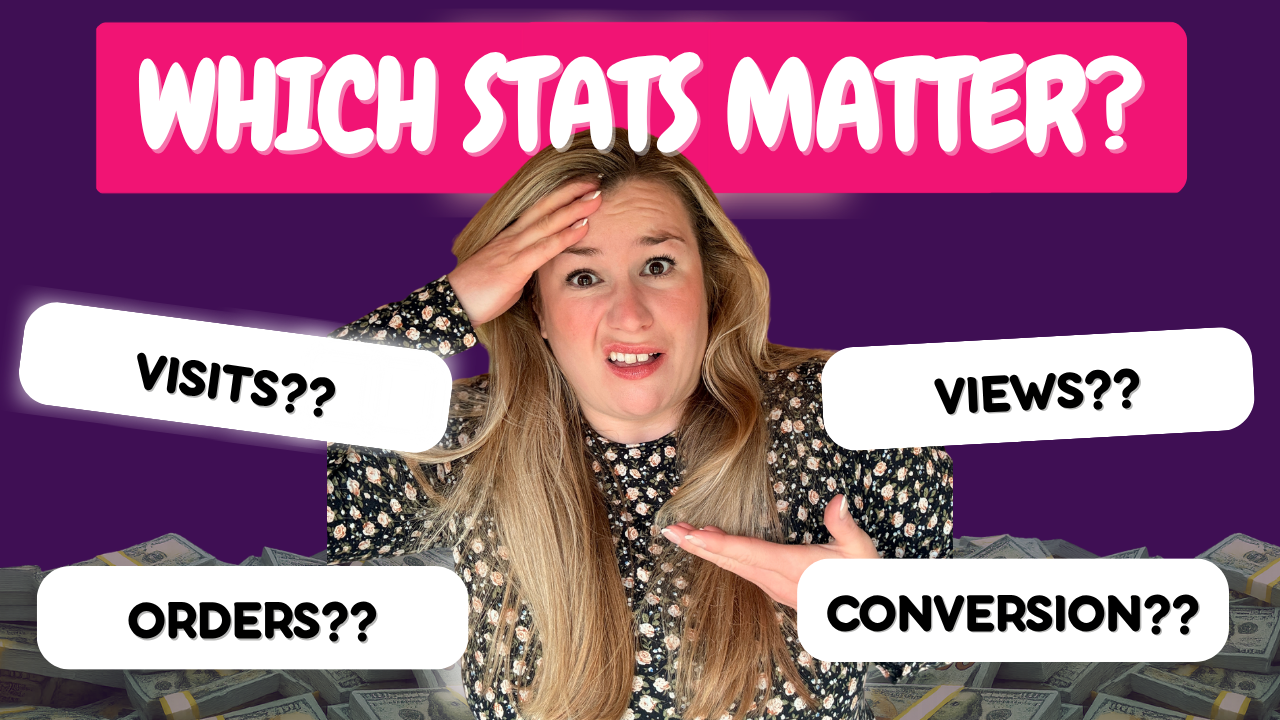
Etsy gives you a lot of numbers, and especially if you are an Etsy beginner, looking at your Stats can be really overwhelming...
It gives you views, visits, favourites, orders, conversion rate, traffic, revenue and all of that sort of stuff.
And even worse, when you start digging into the Stats and analytics, you end up being like "What is all this, and what does it actually mean?"
Then one number drops and you've got that big red downward arrow next to it, and suddenly you're thinking "What do I do? I don't even really know what this number means, but now it's got a red arrow next to it and apparently that's bad."
So the first thing I want you to hear is that you do not need to obsess over every number in Etsy Stats.
You just don't!
Etsy gives you visits, orders, conversion rate and revenue in its main shop-level overview, but today I want to simplify things even further and show you what I would actually use those numbers to understand.
Because your Stats aren't there to give you something new to panic about every morning - they're there to give you clues.
Let's start with visits
The first question is "Are enough people actually arriving?"
Views and visits are different, and this is a really helpful distinction to understand.
A visit is essentially somebody coming into your shop or looking at your listings during a browsing session.
Views are different because one person can look at several listings during that visit...
So let's say we've got Sam.
Sam comes into your Etsy shop.
That's one visit.
But while she's there, she looks at seven different listings.
That could create seven listing views within that one visit.
And that's actually quite useful information because if people are regularly coming into your shop and looking at multiple products, it tells you that they're interested enough to keep having a nosey around.
Your shop may be doing a good job of getting somebody from one listing onto another.
That's cross-selling.
But I'm getting ahead of myself!
If you're worried about sales, the first thing you need to establish is whether people are actually reaching your shop in the first place.
And here's an important side note... Tiny traffic gives you tiny evidence.
Ten visits with no sales does not tell you the same thing as hundreds or thousands of relevant visits with no sales.
So I don't want you looking at ten visits and going "Oh my God. Ten people came to my shop and none of them bought. Everything is broken."
That's not really enough evidence to tell you that.
Whereas if you're getting hundreds or thousands of relevant views and visits and barely any sales are following, now we've got something different to investigate.
If your visits are consistently low, your first question is probably going to be around visibility and relevancy rather than immediately worrying about your conversion rate.
Look at where the traffic is actually coming from
You also want to look broadly at where those visits are coming from...
Is it Etsy Search?
Is it social media?
Is it direct traffic?
Is it advertising?
Where are people actually finding you?
Because that's really useful when you're deciding where to put your energy, time, attention and potentially your money.
If one source is consistently bringing relevant people into your shop, that's information.
If you're spending hours every week on another source and hardly anybody is reaching the shop from it, that's information too.
And this is also where I want you to zoom out...
Please don't judge your entire business based on what happened yesterday.
Or this morning.
Or even necessarily one quiet week.
You've got to zoom out far enough to start seeing useful patterns instead of treating every tiny movement like an instruction to change something.
And if you're looking at all of this thinking "Okay Steph, I can see people are coming into my shop, but I still don't really know why they're not buying..."
that's exactly the point where I'd look at the listing itself before deciding you simply need more traffic.
Once you know whether people are actually arriving, the next thing we can look at is what happens after they get there.
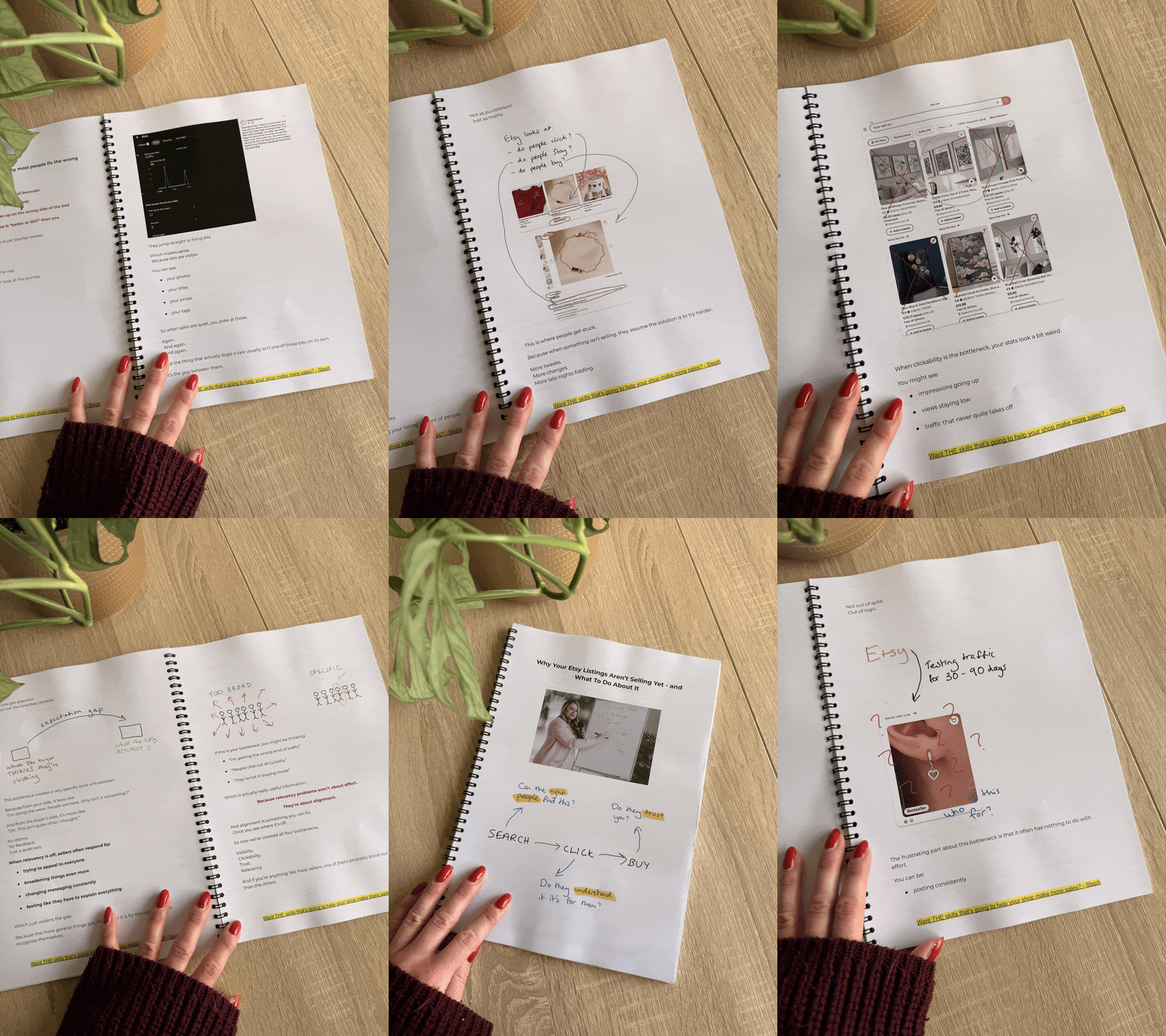
Wondering why your Etsy listings aren't selling?
I've put together a free 72-page guide to help you figure out what's actually stopping the sales and what to do about it.
✅ Find out why people aren't buying
✅ See what needs fixing first
✅ Get a clear plan instead of guessing
GET THE FREE GUIDE →
What does your Etsy conversion rate actually tell you?
Once people are arriving, orders tell you whether some of those visitors are becoming customers.
That bit is fairly obvious.
Your conversion rate starts putting those two things together.
Etsy calculates your shop conversion rate using orders divided by visits.
Notice I said visits, not views.
And conversion rate is useful because traffic on its own can look really impressive.
You could look at a shop with 20,000 views and think "Bloody hell, they're doing amazingly."
But if those 20,000 views are resulting in five sales, we've got a problem somewhere...
Those eyeballs might look lovely on a Stats screen, but commercially they're not doing very much.
So if traffic exists but orders consistently aren't following, that gives you a different problem to investigate.
Now I'd start looking further down the buyer journey.
I'd look at things like...
Is the product clear?
Do people understand what it is and who it's for?
Are the photographs doing their job?
Does the price make sense for the value being shown?
Is delivery clear?
Do you have reviews and trust signals?
Are buyers being left with questions?
Basically, people are reaching the listing but something is stopping them from confidently taking that next step.
Conversion rate doesn't tell you WHAT is wrong
And this is really important... Your conversion rate does not diagnose the exact problem for you.
It doesn't suddenly pop up and go "Steph, photo number three is rubbish. Fix that." unfortunately. 😅
It just tells you that we need to look further down the buyer path.
Think about it really simply...
People arrive.
They look at your listings.
Then some of them buy.
So if you're getting the visits but you're not getting the orders, we need to investigate what is happening between those two things...
It could be price.
It could be value.
It could be trust.
It could be the product.
It could be delivery.
It could be that the wrong people are arriving in the first place.
Conversion rate doesn't hand you the answer - It tells you where to start looking.
That's the useful bit.
Your individual listings give you better clues
This is probably my favourite place to look.
Your overall shop Stats tell you what's happening across the shop - your individual listing Stats can start showing you where it's happening.
Etsy lets you look at things like views, orders, revenue and favourites for individual listings - and now we can start comparing products.
Let's imagine Listing A is getting views but not many sales.
Listing B is getting virtually no views at all.
Those are not the same problem.
Listing A is getting attention.
People are finding it.
So I'd want to understand what's happening once they land on it.
Listing B isn't really getting enough attention in the first place, so that may point us more towards visibility, relevancy or whether buyers actually want that product.
Two listings.
Two completely different jobs.
And this is why I often prefer looking at the individual listing-level Stats rather than only staring at the big shop number.
Learn from the products that are already showing you something
A product that's repeatedly getting interest and orders is worth learning from, and I see people ignore this all the time because they've got a new shiny idea.
They'll be selling jewellery, for example, and sales feel a little bit slow.
Then they think "I know! Digital products!"
And suddenly they've made loads of digital listings, shoved them in the same shop and run off in a completely different direction because the new thing feels exciting.
Meanwhile, one of the existing jewellery products is quietly getting views, favourites and a few orders...
That's the thing I'd be looking at.
What is that product telling us?
Why are people choosing to look at it?
Why does it get more attention than the others?
Is the product itself stronger?
Is the occasion clearer?
Are the photographs better?
Is the price easier to understand?
Does it appeal more strongly to your actual customer?
You already have evidence sitting there - use it!
Don't constantly ignore the information your existing products are giving you because something new feels more exciting.
What do favourites actually mean?
Favourites are another clue, but please don't treat them like miniature orders.
Somebody favouriting something means they were interested enough to save it - that's useful - but it doesn't tell us why they didn't buy.
Maybe they're comparing products.
Maybe they're buying next month.
Maybe they're waiting for payday.
Maybe it's a gift idea for later.
Maybe they liked it but weren't convinced enough to buy.
So if one listing gets loads of favourites and hardly any orders, I'd think "Okay, there appears to be interest here. What's stopping the next step?"
Then I might investigate things like price, delivery, trust, product information or the value being communicated.
What I wouldn't do is go "Lots of favourites means the listing is definitely perfect and Etsy is just being mean."
We don't know that!
Equally, I wouldn't decide the product is rubbish because nobody bought it yesterday.
Stats are clues - not dramatic verdicts.
Revenue isn't the same as profit
Revenue is another number Etsy will show you.
And it's useful because it tells you the value of the sales going through the shop and can help you see which products are contributing more revenue.
But remember... revenue is not profit.
If Etsy says you've done £1,000 in revenue, that does not mean you've got £1,000 sitting there ready to spend.
You've still got materials, packaging, fees, payment processing, your time, advertising if you're using it and all the other costs involved in running the business.
So use revenue as another useful piece of information... don't mistake it for what you actually made.
Don't panic over one quiet day
This is probably one of the biggest things I want you to take from this...
Do not turn Etsy Stats into a daily business report card.
You don't need to log in every morning, see a downward arrow and immediately decide you're failing.
Small shops in particular can have really jumpy numbers because the sample is smaller.
One order can change your conversion rate noticeably.
One busy day can make the week look amazing.
One quiet day can make everything suddenly look terrifying.
That doesn't necessarily mean anything meaningful has changed.
Look for patterns.
Compare useful periods.
Think about seasonality.
Look at what your listings are doing over time.
And give your changes enough time to actually tell you something.
Don't change five things at once either
This is another easy way to make your Stats completely useless.
Sales go quiet, so you change:
The title
The tags
The photographs
The price
The description
The postage
The processing time
Then two weeks later you get more sales - Brilliant!
What worked?
Absolutely no idea. 😂
Because you've changed half the shop at once.
Make fewer, more deliberate changes...
If hardly anybody is reaching a listing, investigate visibility.
If people are seeing it but not choosing to click, look at how it appears to them.
If people are clicking but not buying, investigate the buying decision.
If one product is consistently doing better than everything else, work out what that product can teach you.
Use the Stats to narrow the problem - not create twelve new ones.
The simple Etsy Stats check I'd use as a beginner
If this is your first time properly looking at Etsy Stats, I don't want you analysing every single number Etsy gives you.
Start with a useful date range and ask yourself "Are people actually reaching my shop?"
Look at your visits.
Then "Are those visits turning into orders?"
Look at your orders and conversion rate.
Then go into your individual listings...
Which products are getting the most attention?
Which are getting orders?
Which get views but very few sales?
Which barely get seen at all?
Then look at where your traffic is coming from.
Does the traffic actually make sense for what you sell?
And from all of that, ask "Where does the buyer appear to stop?" ...that's the bit I want you working on first - not every number, not the whole shop...
Just the part the evidence is pointing you towards.
Your Etsy Stats are there to help you make better decisions
So that's really the big takeaway.
Your Stats aren't there to tell you whether you're a good business owner today.
They're not there to make you panic because Tuesday was worse than Monday.
They're there to help you understand what is actually happening...
Are enough people finding you?
Are those people looking at the right products?
Are they buying?
Which products are doing better?
Where is your useful traffic coming from?
And where does the pattern appear to change?
Use your Etsy Stats as clues - not a daily report card.
Because once you understand what those numbers are actually telling you, it becomes a lot easier to work out what deserves your attention next...
And a lot easier to leave the rest alone!


